翻訳ツールの精度は、翻訳する前の文の内容や文脈によりますが、ビジネス文章においてどのサービスが一番翻訳精度が高くなるかを調査しました。
評価軸としての以下の尺度で、それぞれ100点満点で評価を行いました。
- 翻訳精度
- 言語の流暢さ
- 翻訳の一貫性
- 文化的妥当性
- 文章の正確さ
- 総合評価
採点基準としては以下の通りです。
- 50点以下: かろうじて意味は通じる
- 60点〜: 多少違和感があるがとりあえず文章は読むことができる
- 70点〜: ほとんど違和感がない
- 80点〜: ほとんどネイティブの人間が書く文章に近い
- 90点〜: プロの翻訳者レベル
今回翻訳する文章はこちらです。
著作権の保護の歴史は非常に古く、15世紀中頃の印刷術の発明に始まるといわれ、
ヨーロッパ諸国では18世紀から19世紀にかけて、著作権の保護に関する法律が作られました。
また、多くの国々が陸続きで接し合うヨーロッパでは、
著作権は国を越えて保護しなければ意味がないため、
19世紀後半から、ヨーロッパ各国の間で、
二国間条約による相互保護が行われてきましたが、
明治19年9月9日、10カ国がスイスのベルヌに集まり、
いわゆる「ベルヌ条約(文学的及び美術的著作物の保護に関するベルヌ条約)」が作成されました。
翻訳前の原文は一文節が長く、また、専門用語も一部混ざる点や和暦(明示19年)が含まれるため、一般的に機械翻訳においては誤りが発生しやすい文章です。
こちらの文章を元にそれぞれ翻訳した点数を見ていきます。
追記(2025年11月4日)
本記事(初出:2024年3月)のアップデートとして、同一原文を用い、GPT-5で再翻訳・再採点しました。評価軸と配点(各100点、採点基準)は当時と同一です。比較対象は当時のChatGPT(GPT-4-Turbo) の訳文です。
GPT-5 英訳
Copyright protection has a very long history, said to begin with the invention of
printing in the mid-15th century.
Across Europe, laws governing copyright protection were enacted from the
eighteenth through the nineteenth century. Because many European countries
share land borders, copyright would be ineffective unless protected beyond
national boundaries.
Accordingly, from the latter half of the nineteenth century,
European states provided reciprocal protection through bilateral treaties.
On September 9, 1886 (Meiji 19), representatives of ten countries met in Berne,
Switzerland, and drafted the Berne Convention (the Berne Convention for the
Protection of Literary and Artistic Works).
短評
- GPT-5:長文節の英文化で過不足なく情報を保持。直訳調を避けつつ、法制度の時制・論理関係(因果→「Accordingly」)が明確。和暦の正確な西暦化(明治19年→1886年)と、条約正式名の丁寧な添え書きが好適。
- GPT-4-Turbo(当時):意味伝達は良好だが、接続の単調さと句読点配置のばらつきで読み心地に僅かな粗。用語注記(正式名・都市名表記の統一)で一貫性にやや欠ける。
追記時点での要旨
総合点でGPT-5がChatGPT(GPT-4-Turbo)よりも+5pt上回り、可読性・一貫性・事実記述の精度で安定した改善が見られました。こと翻訳においてはChatGPTのモデルにおいては常に最新の上位モデルを選んでおけば間違いはないことが見受けられます。
(追記ここまで)

Google翻訳
Copyright protection has a very long history, dating back to the invention of printing in the mid-15th century,
and laws regarding copyright protection were enacted in European countries from the 18th to the 19th century.
Furthermore, in Europe, where many countries are connected by land,
copyright is meaningless unless it is protected across borders,
so mutual protection has been implemented between European countries through bilateral treaties since the late 19th century.
However, on September 9, 1888, ten countries gathered in Berne, Switzerland,
and created the so-called Berne Convention (Berne Convention for the Protection of Literary and Artistic Works).
総評) 全体的に読みやすい文章で、原文の意味を正確に捉えて翻訳できている。ただし、一部の表現が直訳のため不自然で、専門用語の訳が適切でない。
DeepL
The history of copyright protection is very old, beginning with the invention of the art of printing in the mid-15th century, and laws concerning copyright protection were created in the 18th and 19th centuries in European countries.
In Europe, where many countries border each other on land, copyrights are meaningless unless they are protected across national boundaries,
and since the latter half of the 19th century,
mutual protection has been provided by bilateral treaties among European countries.
On September 9, 1887, ten countries met in Berne,
Switzerland, and the so-called Berne Convention (Berne Convention for the Protection of Literary and Artistic Works) was drawn up.
総評) 原文の核心は伝えているが、不自然さ、単調さ、また日付誤り(正しくは1886年)などの誤訳などが目立つため、翻訳としての洗練さに欠ける。
ChatGPT翻訳
The history of copyright protection is ancient,
and it is believed to have originated with the advent of the printing press in the mid-15th century.
In Europe, copyright protection laws were enacted
between the 18th and 19th centuries.
Given that numerous European countries are connected by land,
copyright protection needed to be enforced beyond national boundaries
to be effective. Consequently,
from the latter half of the 19th century,
bilateral treaties for reciprocal protection were negotiated among European
nations. On September 9, 1886, delegates from 10 countries convened in Bern,
Switzerland, to establish the 'Berne Convention for the Protection of Literary and Artistic Works'.
総評) 一部の表現が冗長な部分もあるが、原文の意味を正確に伝えつつ、読みやすい文章になっている。
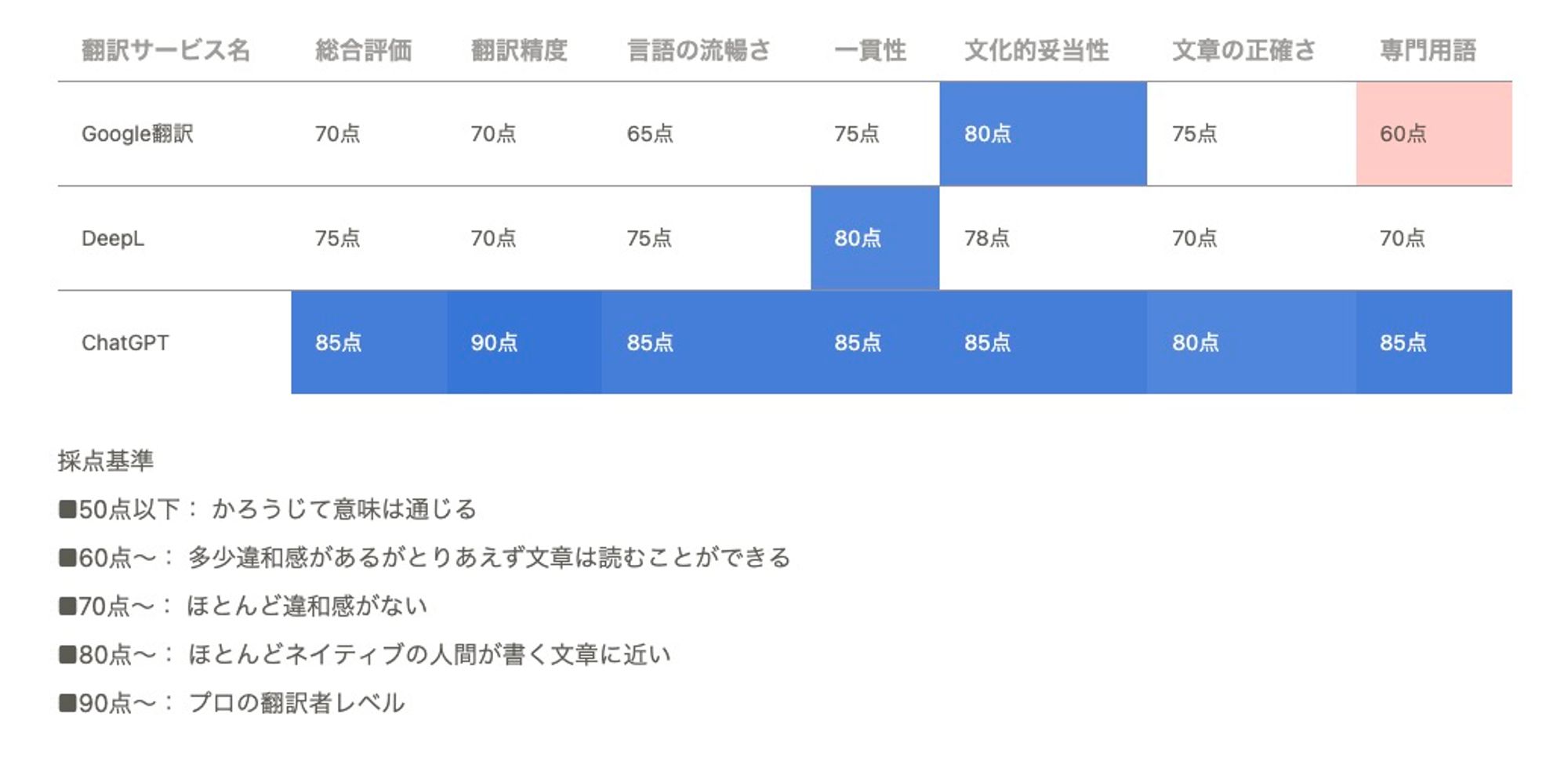
採点結果
上記の翻訳結果を基にそれぞれ採点を行いました。
結果は以下の通りです。

総合的に見ると、DeepLは文学的なテキストの翻訳に優れ、Google翻訳は一般的なフレーズに対して高い精度を持ち、ChatGPTはトータルのバランス良くプロレベルに限りなく近い翻訳ができると言えそうです。